
product image

select caret down
Login

Note: The content of this article is for general information purposes only. It does not replace medical or nutritional advice and does not constitute health-related statements about our products.

– Before you read on –

We don't just know everything about Kombucha ...

We also brew the best raw kombucha ourselves. If you're thirsty, stop by our shop and see for yourself!

Try kombuchery

I can answer that with a clear "Yes". What the mushroom does for tea, it can also do for you: provide you with a wealth of nutrients. In this blog post, you'll find out why you should try Scoby, delicious tea mushroom recipes, and the latest Scoby trends.

What Scoby can do

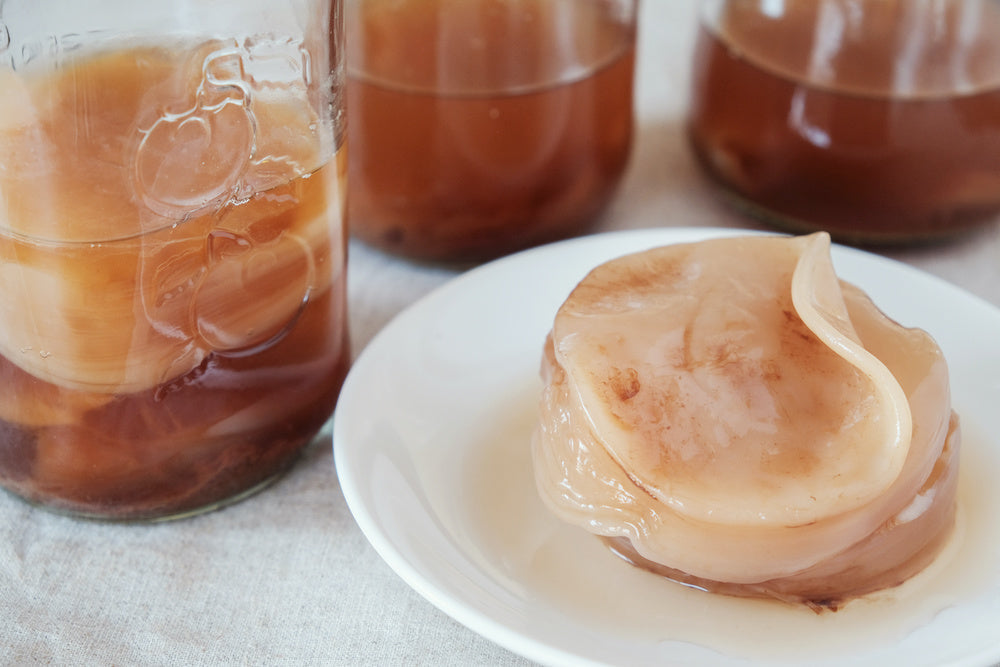
The SCOBY (SYMBIOTIC CULTURE OF BACTERIA AND YEASTS) – botanically speaking, a lichen – has been known for centuries and is an amazing growth: it lives, thrives and gives us the health-promoting, delicious Kombucha.

Those who brew Kombucha at home know that the tea mushroom grows larger over time and eventually you have more Scobys than you need. This raises the question of whether you can do more with the excess tea mushroom.

What does a SCOBY consist of?

  • Cellulose
  • Bacterial cultures (e.g. lactic acid and acetic acid bacteria)
  • Yeast cultures
  • Microorganisms
  • Interaction in a kind of symbiosis

Why should you eat Kombucha tea mushroom?

The Scoby...

  • is the source of beneficial bacteria in Kombucha
  • contains insoluble fiber, which is extremely gut-friendly
  • helps to regulate blood sugar levels
  • has an alkaline effect on our body
  • has hardly any calories yet provides a pleasant feeling of fullness
  • absorbs excess cholesterol in the bloodstream
  • is full of vitamins, minerals, enzymes and trace elements

These are convincing arguments to simply try Scoby. Of course, the tea mushroom can simply be cut into small pieces and eaten. However, there are no limits to creativity if the taste is still a bit unusual for the first try.

Two glasses of Kombucha with tea mushrooms on a wooden box

What can we use the Kombucha mushroom for?

The edible tea mushroom: A new trend, like jerky or fruit gum? Scoby as a beauty mask, foot bath, pet food, or even as a leather substitute? I would like to give you an overview followed by a recipe section.

1. Alternative to fish in sushi

Especially for vegetarians, the use of Kombucha tea mushroom is a very attractive alternative to fish. When cooked, Scoby's consistency is reminiscent of calamari. Scoby is particularly popular as a substitute for fish in sushi. If you want to preserve all the nutrients of Scoby, it is best to use it raw.

2. Latest trend: Scoby Jerky

Marinate the Scoby in your favorite sauce for 24 hours and then lay it flat on a piece of baking paper. Dry it at 30 to 40 °C until it is dry and has a jerky-like consistency. Tip: All foods processed at up to 42 °C are still considered raw and most of the valuable ingredients are still preserved.

3. Make delicious Kombucha smoothies

Smoothies get a special nutrient boost from a few pieces of Scoby. The tea mushroom goes well with green smoothies, sweet berry smoothies, or in a breakfast bowl.

4. Scoby for your pet

Scoby can also have a beneficial effect on your pets, whether dog, cat, rabbit, or horse, and do good for their metabolism. Try a piece of tea mushroom to see if they like it.

5. Other uses for the tea mushroom

  • For your beauty: As a face mask, hair treatment, or foot bath. Your skin and hair will thank you.
  • For wounds or sunburn: Apply pureed Scoby to minor wounds or skin infections. Mixed with some aloe vera gel, the tea mushroom is a soothing lotion after sunbathing.
  • Humus for your flowers: Simply put the Scoby on the compost instead of in the trash.
  • Scoby as a leather substitute: Scoby not only serves as a plastic packaging substitute, but is also professionally produced as so-called "vegan leather".

Exciting Scoby Recipes

Berry Scoby Smoothie

Ingredients:

  • 30 g Scoby
  • 60 g frozen strawberries
  • 100 ml rice milk or other milk substitute
  • 100 ml Kombucha Original
  • a little honey or maple syrup

Preparation:

Blend everything and your power smoothie is ready!

Applesauce with Scoby

Ingredients:

Preparation:

Cut the apples into pieces. Then add them to the Kombucha with Scoby and blend everything until the desired consistency is reached. If desired, cinnamon or a little coconut blossom sugar can also be added. Be sure to store the finished applesauce in the refrigerator.

Tip: If you use a stand mixer, you can just remove the apple stems and leave the cores and core housing. These are valuable fiber that cleanse your intestines, and the pectin in the cores is good for your gut bacteria.

Scoby Energy Balls

These delicious energy balls help you to refuel and get back on your feet quickly after a short slump.

Ingredients:

  • 125 g rolled oats
  • 40 g dried cherries, dates or figs
  • 50 g nut butter
  • 3 spoonfuls of honey
  • vanilla powder, cinnamon or other spices to taste
  • 30 g Scoby

Preparation:

Mix all ingredients well and store in the refrigerator for at least 1 hour. Then use a spoon to separate the dough and form small balls. Afterwards, store the finished Scoby Energy Balls in the refrigerator again.

Strawberry-Scoby Sorbet with Rose Petals

Ingredients (makes approx. 750 ml sorbet):

  • 500 g prepared strawberries
  • 100 g honey
  • 150 ml Kombucha Original
  • 2 cl rose essence
  • Juice of 1 lemon
  • 1/2 packet apple pectin
  • 2 handfuls of rose petals

Preparation:

  1. Wash the strawberries and put them in the blender.
  2. Then add honey, lemon juice, Kombucha, and apple pectin. Puree the ingredients and season the sorbet mixture with lemon and rose essence. The strawberry-Kombucha sorbet should now thicken slightly due to the pectin.
  3. Pluck the rose petals and sprinkle them into the sorbet mixture.
  4. The sorbet mixture is now frozen in an ice cream machine, or you can fill the mixture into ice cream molds and let them freeze in the freezer. The soft sorbet also tastes great unfrozen.
Scoby Jerky ready on plate

Scoby Jerky

Ingredients:

  • 5 to 6 thin Kombucha Scobys
  • 1 tablespoon grated ginger
  • 1 tablespoon diced garlic
  • 120 ml soy sauce
  • 7 tbsp honey

Preparation:

  1. Cut the Scobys into strips.
  2. Mix the remaining ingredients to make a marinade and soak the Scoby for 24 hours.
  3. Place the Kombucha Scobys in strips on the tray of your dehydrator.
  4. Dehydrate the strips until most of the moisture is gone (approx. 8 hours at 40 °C).
  5. Store your Scoby jerky at room temperature in an airtight jar and consume within one month.

Notes

The easiest way to get thin Scobys for this recipe is to carefully peel off the top layer of the kombucha tea mushroom. Alternatively, you can try to separate a thick Scoby into layers.

If you don't have a dehydrator, you can prepare your Scoby jerky in the oven. Simply set the oven to the lowest temperature and leave the door ajar with a wooden spoon.

Scoby Fruit Gums

Tools:

  • Blender
  • Dehydrator
  • Baking paper or dehydrator sheets
  • Offset spatula
  • Pizza cutter or scissors

Ingredients:

  • 500 g Scoby
  • 125 g fruit puree (strawberry or mixed with raspberry puree)
  • 25 g cup organic sugar

Preparation:

  1. Puree the fruits, add the sugar to the fruits and set the mixture aside.
  2. Puree the Scoby in the blender at medium speed.
  3. Add the fruit puree and continue blending until everything is well mixed.
  4. Cut the baking paper to fit the dehydrator tray.
  5. Pour the Scoby fruit mixture onto the paper on the rack.
  6. Spread the mixture with an angled spatula to all edges (about 1/2 cm thick).
  7. Follow steps 1 to 5 until all trays are filled.
  8. Dehydrate the mixture at 30 °C for 24 to 36 hours or until the mixture is dry and no longer sticky.
  9. Remove the dried mixture from the dehydrator and place it on a cutting board.
  10. Using a pizza cutter or scissors, cut 1/2 cm wide strips across the entire dried Scoby fruit mass.
  11. Leave the dried Scoby fruit gum on the parchment paper and roll up the Scoby fruit.
  12. Store in an airtight container.
  13. Remove the Scoby fruit gum from the paper before consumption.

ENJOY!
7 comments

    • Nico
    • October 15, 2024 at 10:33 am

    Sehr cooler Beitrag werde ich mal probieren. Meine Scoby´s werden immer größer und ich will nicht noch mehr Kombucha machen… wer soll denn das ganze Trinke :D.

    • Ines Heinrich
    • June 23, 2021 at 4:29 pm

    Der Artikel über den Scoby und seine Möglichkeiten ist sehr interessant, dass man den essen kann, hab ich nicht erwartet, weil er so gummiartig wirkt. Aber man lernt, dank Euch, nie aus.

Leave a comment

Please note, comments need to be approved before they are published.

This site is protected by hCaptcha and the hCaptcha Privacy Policy and Terms of Service apply.

Note: This article is intended for informational purposes only and should not be construed as professional analysis, advice, or medical information. It contains the author's personal opinion based on researched literature and personal experience on the subject.

Recommended articles for you

You can find more of my articles, from A, like non-alcoholic kombucha cocktails, to Z, like lemon-ginger kombucha, on our Kombuchery blog. Let's learn more about kombucha together!

View all

Kombucha Guide Berlin: Die 10 besten Cafés & Restaurants in 5 Bezirken

Kombucha Guide Berlin: The 10 Best Cafes & Restaurants in 5 Districts

Urban Wellness in Berlin: 5 Neighborhoods Where You'll Find Great Kombucha Berlin is one of Europe's most exciting cities when it comes to modern food and drink culture. Kombucha is no longer a niche product here, but part of a...

Read moreabout Kombucha Guide Berlin: The 10 Best Cafes & Restaurants in 5 Districts

Wer kann mehr? Der Vergleich: Kombucha, Brottrunk & funktionale Limonaden

Who Can Do More? The Comparison: Kombucha, Brottrunk & Functional Lemonades

In recent years, the range of beverages available has changed significantly. In addition to classic soft drinks, more and more fermented beverages and so-called functional lemonades are available in supermarkets today. Particularly popular are kombucha, kvass, and modern lemonades with...

Read moreabout Who Can Do More? The Comparison: Kombucha, Brottrunk & Functional Lemonades

Kombucha und seine Wirkung: Wissenschaftliche Studien zu Inhaltsstoffen, Fermentation und Gesundheit

Kombucha and Its Effects: Scientific Studies on Ingredients, Fermentation, and Health

Kombucha is one of the most intensively researched fermented beverages in recent years. Modern microbiological, nutritional, and clinical studies show that the drink possesses an exceptionally complex biochemical composition. During fermentation, numerous bioactive compounds are formed, including organic acids, polyphenols,...

Read moreabout Kombucha and Its Effects: Scientific Studies on Ingredients, Fermentation, and Health

🌍 World Kombucha Day am 21. Februar: Geschichte, Fakten & Tipps zum Feiern

🌍 World Kombucha Day on February 21: History, Facts & Tips for Celebrating

Celebrate the Effervescent History of Kombucha Every year on February 21st, kombucha fans worldwide celebrate World Kombucha Day. But why exactly does this day exist? It's simple: it's a tribute to a beverage that has delighted, inspired, and refreshed people...

Read moreabout 🌍 World Kombucha Day on February 21: History, Facts & Tips for Celebrating

Die besten Nahrungsergänzungsmittel: Gesundheit gezielt stärken ohne Risiko

The Best Nutritional Supplements: Targeted Health Boosts Without Risk

Dietary Supplements: Beneficial for all who can't live perfectly healthy every day In a stressful everyday life, many people can't always manage to eat optimally healthy every day. Shift work, long days in the office, little time for fresh cooking,...

Read moreabout The Best Nutritional Supplements: Targeted Health Boosts Without Risk

Darmkuren im Check: Was wirklich wirkt

Bowel Cleanses Under Scrutiny: What Really Works

Colon cleanses, detox programs, and so-called "bowel purifications" have enjoyed great popularity for years. They promise a fresh start for the body, more energy, better digestion, and increased well-being. Especially in the context of gut health, such promises seem plausible...

Read moreabout Bowel Cleanses Under Scrutiny: What Really Works

Präbiotische/ probiotische Hautpflege: Hilft sie wirklich?

Prebiotic/probiotic skincare: Does it really work?

Prebiotic and Probiotic Skincare: Trend or Scientifically Effective? The Skin Microbiome: A Complex Ecosystem The skin is the largest human organ and a complex ecosystem inhabited by a multitude of microorganisms, collectively known as the skin microbiome. This consists of...

Read moreabout Prebiotic/probiotic skincare: Does it really work?

Wozu braucht der Körper Präbiotika?

Why does the body need prebiotics?

Prebiotics are often overshadowed by their more well-known "relatives," probiotics. While probiotics are living microorganisms that we ingest through food or supplements, prebiotics serve as food for the beneficial bacteria in the gut. They are, so to speak, the fuel...

Read moreabout Why does the body need prebiotics?

Wie viel Kombucha ist gut für dich?

How much kombucha is good for you?

How much kombucha is good for me? Our tips on dosage, duration of use and what your body really needs Kombucha is more than just a trendy drink - it's alive, naturally fermented, and packed with microorganisms. But how much...

Read moreabout How much kombucha is good for you?

Neue Rezeptur mit Vitamin C aus Acerola: *Vitamin C trägt zu einer normalen Funktion des Immunsystems, einem normalen Energiestoffwechsel sowie zum Schutz der Zellen vor oxidativem Stress bei.
  • Vitamin C trägt zu einer normalen Funktion des Immunsystems bei.
  • Vitamin C trägt zu einer normalen psychischen Funktion bei.
  • Vitamin C trägt zu einem normalen Energiestoffwechsel bei.
  • Vitamin C trägt zur Verringerung von Müdigkeit und Ermüdung bei.
  • Vitamin C trägt zu einer normalen Funktion des Nervensystems bei.
  • Vitamin C trägt dazu bei, die Zellen vor oxidativem Stress zu schützen.
  • Vitamin C trägt dazu bei, die reduzierte Form von Vitamin E zu regenerieren.
  • Vitamin C trägt zu einer normalen Kollagenbildung für eine normale Funktion der Haut bei.
  • Vitamin C trägt zu einer normalen Kollagenbildung für eine normale Funktion der Blutgefäße bei.
  • Vitamin C trägt zu einer normalen Kollagenbildung für eine normale Funktion der Knochen, der Knorpel, der Zähne und des Zahnfleisches bei.
  • Vitamin C erhöht die Eisenaufnahme.